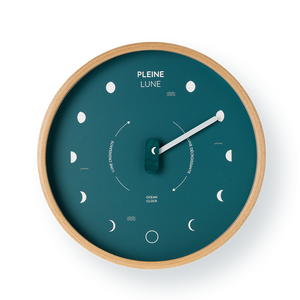
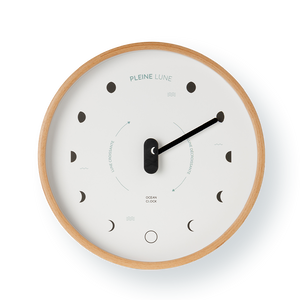
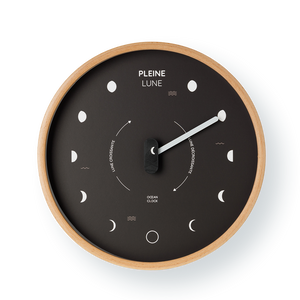
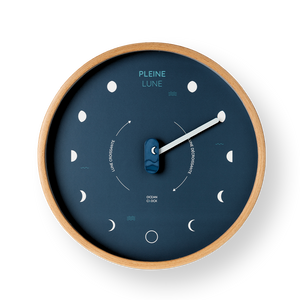
Settings & Calibration

Tide Clocks

Learn how to set your tide clock with these detailed explanations on how it works, what you need to know and how to set it!

How to set a tide clock

A tide clock requires an initial setting before it is used for the first time. Although this can be done manually, the result is often approximate.

That is why we have designed an easy-to-use setting tool that guides you step by step and provides a more precise setting based on your location and the natural variations in the tides throughout the year.

How to set a tide clock accurately

A correct initial setting helps reduce the variations observed throughout the year, which is why this step is so important.

➡︎ Simply enter the name of your coastal town or city in the tool.
➡︎ The hand will then appear virtually on the clock face.

This step allows you to see exactly how to position the hand so that your tide clock indicates the local tide trend.

The interactive tide clock below shows you where to position the hand right now 👇

Understand it at a glance!

1. Find the tide times

2. Set your tide clock

⮕ Position the hand as shown above using the adjustment wheel on the back of the clock, then insert the battery.

🔋 Recommended batteries: Duracell Plus or the yellow Varta Longlife.

Variations

A slight difference may appear between the time shown on your tide clock and the times given in a tide timetable. This is perfectly normal and results from natural variations in the lunar cycle.

These differences remain limited and naturally balance out over successive tides. They are mainly noticeable during periods of low tidal coefficients.

👉 There is therefore no need to readjust your tide clock.

Learn more about our setting tool

The initial setting allows the hand to synchronise with the tide cycle of your chosen location. If it is not carried out correctly, the clock will lose accuracy and will no longer reflect the actual state of the tides.

This initial setting is essential, as tides are a natural phenomenon that changes every day. Once correctly set, your tide clock will naturally follow the rhythm of the tides and will not need to be adjusted again, except if you change location or replace the battery.

A correct initial setting allows you to get the most out of your tide clock, particularly when planning your activities along the coast.

Why use our setting tool?

To achieve the most accurate setting for your Ocean Clock tide clock, our tool takes into account several key parameters to provide a more precise reading of the tides.

Unlike a traditional manual setting, it takes into account the phases of the Moon, the tidal coefficient and the specific characteristics of your chosen location.

These factors directly influence tidal movements and provide a significantly more accurate setting than a standard manual adjustment.

The tool automatically calculates the information for your chosen location. When the hand appears on the screen, simply position the hand on your tide clock in exactly the same way.

Once this setting is complete, your tide clock operates entirely on its own. You will not need to adjust it again, except if you change location or replace the battery.

This tool was designed by Ocean Clock to make setting your tide clock simpler, more intuitive and more accurate, while taking into account the actual tidal conditions of your chosen location.

Réglage horloge des marees Ocean Clock Réglage horloge des marees Ocean Clock Réglage horloge des marees Ocean Clock Réglage horloge des marees Ocean Clock

Réglage horloge des marees Ocean Clock

A tide clock reproduces the average tidal cycle, with 12 hours and 25 minutes between two high tides. Once set for your chosen coastal location, it allows you to see the tide trend at a glance.

💡 Visit our How it works page to learn more about how tide clocks work and view the map of compatible areas.

Yes. A tide clock works anywhere, even if you live far from the sea. Simply set it for the coastal location of your choice.

⚠️ However, it is only suitable for regions where the tides follow a regular cycle, such as the Atlantic coast (Europe and North America), the English Channel and much of the British coastline. It is not suitable for the Mediterranean, where tides are very weak.

💡 To check whether your coastline is compatible, visit our How it works page. There, you’ll find an interactive map of compatible areas, along with everything you need to know about how a tide clock works.

A tide clock is not intended to replace a tide timetable, which provides precise tide times. It is designed to show the tide trend and provides a useful reference for water-based activities.

👉 Slight differences may occur between the tide shown on the clock and the times given in a tide timetable. This is perfectly normal and is caused by natural variations in the lunar cycle 🌖

These differences, which can reach up to 1 hour, remain limited. They are mainly noticeable during periods of 🌊 low tidal coefficients and naturally balance out over successive tides.

〽️ View the tide clock variation curve here

Your tide clock is designed to follow the average time between two high tides, which is 12 hours and 25 minutes. In nature, however, this interval varies slightly from day to day depending on the phases of the Moon, the position of the Sun and the characteristics of the coastline.

👉 These natural variations explain the slight differences you may sometimes notice compared with a tide timetable. They are perfectly normal and naturally balance out over the lunar cycles.

❌ Once correctly set, a tide clock is designed to work independently. It is therefore not recommended to readjust it constantly, as this could interfere with its natural operation.

To get the most out of your tide clock, it is important to understand that slight variations are a normal part of how it works.

Yes 👌 Our tide clocks are fitted with a continuous sweep movement, with no ticking sound.

👉 This provides a smooth and silent display, ideal for any room in the home, including a bedroom.

🔋 They run on a 1.5 V AA alkaline battery.
Using the correct battery is essential to ensure the movement works properly and remains accurate. Rechargeable or high-power batteries are not recommended, as their voltage can affect the accuracy of the movement.

➡️ Recommended by our workshop: Duracell Plus or Varta Longlife (all-yellow version).

We recommend using a 1.5 V AA alkaline battery.

❌ Rechargeable, lithium or high-power batteries are not recommended, as their voltage can vary and affect the correct operation of the movement.

✅ The batteries we use and recommend in our workshop are Duracell Plus and Varta Longlife (all-yellow version). They provide the best results in terms of accuracy and battery life.