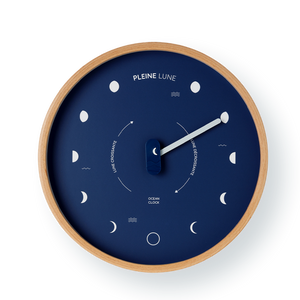
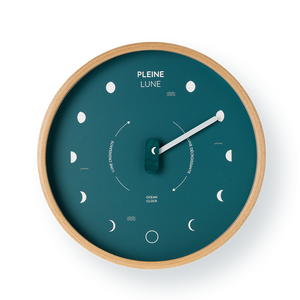
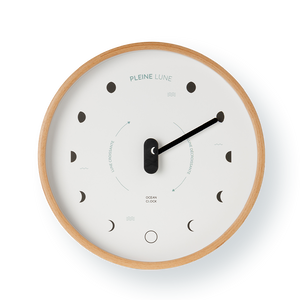
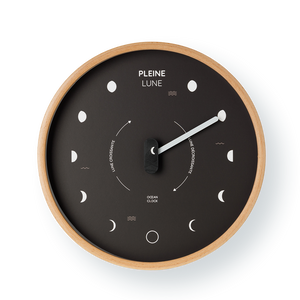
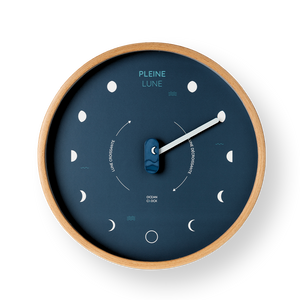
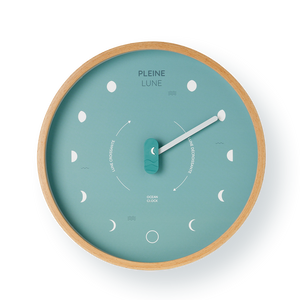
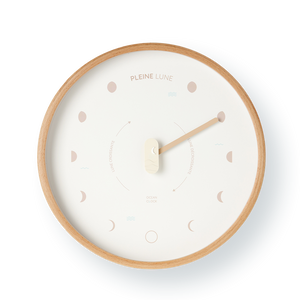
The Ocean Clock hygrometer: battery-free and crafted from wood
The operation of a hygrometer is based on the reaction of a humidity-sensitive element to the moisture present in the air.
As humidity levels rise or fall, this element expands or contracts,
causing the needle to move across the dial.
A battery-free mechanical hygrometer
The Ocean Clock hygrometer operates without batteries.
It uses humidity-sensitive materials to move a needle mechanically.
Like other Ocean Clock measuring instruments, it is a low-tech product,
designed to last and function with simplicity.
No batteries, no screen, no charging required: the bimetal hygrometer displays humidity levels
through a simple and durable mechanical movement.
A wooden hygrometer assembled in Hossegor
Each wooden hygrometer is hand-assembled in our workshop in Hossegor, in south-west France.
Inspired by the world of the ocean and traditional measuring instruments,
our models combine minimalist design, mechanical operation and French craftsmanship.
Mechanical hygrometer or hair hygrometer?
There are several types of hygrometers. A hair hygrometer uses a natural hair
or a humidity-sensitive fibre. As the air becomes more humid, the fibre relaxes slightly.
When the air becomes drier, it contracts. This movement mechanically drives the dial needle.
A mechanical hygrometer, on the other hand, measures air humidity without any electrical power source.
It provides an immediate and easy-to-read indication while maintaining an attractive decorative appearance.
Which hygrometer should you choose?
Depending on the model, the sensitive element may be an electronic humidity sensor, natural hair, a synthetic fibre or a bimetal mechanism.
| Type of hygrometer |
Power source |
Accuracy |
Maintenance |
Appearance |
| Mechanical hygrometer |
Battery-free |
Good accuracy when calibrated |
Low |
Highly decorative |
| Electronic hygrometer |
Battery-powered |
Very accurate |
Battery replacement |
More technical appearance |
| Digital hygrometer |
Battery or USB powered |
Very accurate |
Charging or battery replacement |
Modern screen-based design |
A hygrometer helps you better understand the air inside your home:
whether it is too dry, comfortably balanced or excessively humid.
What humidity level is recommended indoors?
The ideal humidity level depends on the room and its use.
A hygrometer makes it easy to check whether the air in your home remains within a comfortable range.
| Room |
Recommended humidity level |
| Living room |
40–60% |
| Bedroom |
40–60% |
| Nursery |
40–60% |
| Wine cellar |
Around 70% |
Air that is too dry can cause discomfort or irritation, while excessively humid air encourages condensation, unpleasant odours and mould growth.