Settings & Calibration

Tide Clocks

Discover how to get the most out of your tide clock with these detailed explanations on how it works, how to understand it, and how to set it!

What does the hand indicate?

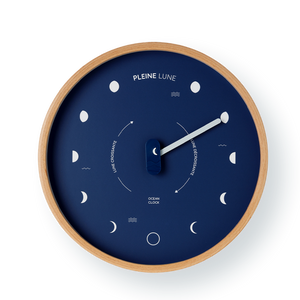
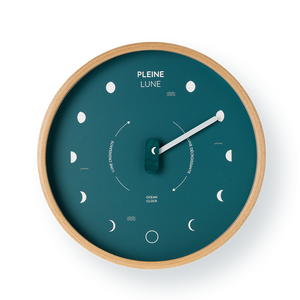
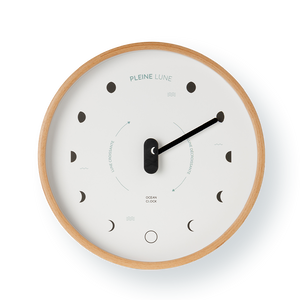
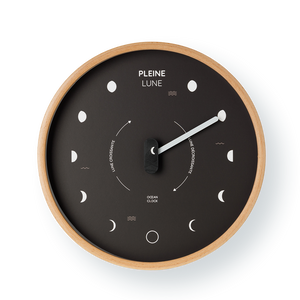
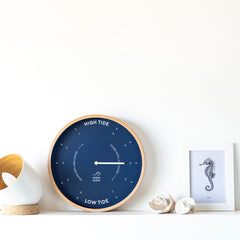
The position of the hand lets you see how the tide is changing at a glance:

→ To the left of the dial: the tide is rising.

→ To the right of the dial: the tide is falling.

Simple and intuitive, so the whole family can keep track of the tide every day.

How to read a tide clock

Unlike a traditional clock that tells the time, a tide clock is designed to indicate the state of the tide.

A customisable hand allows you to easily follow the changing tide.

→ The dial displays “High tide” and “Low tide”, as well as the time remaining before the next high or low tide.

Since 2015, Ocean Clock has reimagined this instrument with a sleek, contemporary design that is as useful as it is decorative.

HIGH TIDE OR LOW TIDE?

The tide transforms the coastline throughout the day and offers different opportunities depending on its level.

At low tide, the sea recedes, revealing vast stretches of beach. This is the ideal time to take a stroll along the sand, go shellfish gathering, explore the rocks or discover the foreshore. Indeed, some beaches and certain passages are only accessible at low tide.

At high tide, the sea gradually covers the coastline and approaches the top of the beach. It can be particularly enjoyable for swimming, certain types of surfing, stand-up paddleboarding or water sports, depending on the conditions and the layout of the beach.

👉 So, should you go for high tide or low tide to make the most of the beach?...

High tide or low tide: when is the best time?

There is no single ideal tide for every activity: the best time depends above all on what you want to do and where you are.

For surfing, for example, some spots offer better conditions at low tide, while others are more suitable at high tide or on a rising tide. Swell, wind, currents and the shape of the seabed are all important factors to consider before heading into the water.

For fishing, it also depends on the activity. Shore foraging is best at low tide, when the sea reveals the foreshore and provides access to shellfish and crustaceans. For surfcasting, on the other hand, a rising tide can be a good time to fish. When sailing, water depth and currents can also determine whether certain passages are accessible.

Before heading out, information about tide times, tidal coefficients and conditions can help you choose the best time for your plans. On a daily basis, our tide clock provides a simple guide: at a glance, you can see the state of the tide, whether it is rising or falling, and estimate the time remaining before the next high or low tide.

This makes it easy to decide when to go to the beach depending on your plans: swimming, walking, shore foraging, surfing or other water activities.

⮕ Discover our illustrated article HERE

Frequently asked questions about tide clocks

A tide clock reproduces the average tidal cycle, with 12 hours and 25 minutes between two high tides. Once set for your chosen coastal location, it allows you to see the tide trend at a glance.

💡 Visit our How it works page to learn more about how tide clocks work and view the map of compatible areas.

Yes. A tide clock works anywhere, even if you live far from the sea. Simply set it for the coastal location of your choice.

⚠️ However, it is only suitable for regions where the tides follow a regular cycle, such as the Atlantic coast (Europe and North America), the English Channel and much of the British coastline. It is not suitable for the Mediterranean, where tides are very weak.

💡 To check whether your coastline is compatible, visit our How it works page. There, you’ll find an interactive map of compatible areas, along with everything you need to know about how a tide clock works.

A tide clock is not intended to replace a tide timetable, which provides precise tide times. It is designed to show the tide trend and provides a useful reference for water-based activities.

👉 Slight differences may occur between the tide shown on the clock and the times given in a tide timetable. This is perfectly normal and is caused by natural variations in the lunar cycle 🌖

These differences, which can reach up to 1 hour, remain limited. They are mainly noticeable during periods of 🌊 low tidal coefficients and naturally balance out over successive tides.

〽️ View the tide clock variation curve here

Your tide clock is designed to follow the average time between two high tides, which is 12 hours and 25 minutes. In nature, however, this interval varies slightly from day to day depending on the phases of the Moon, the position of the Sun and the characteristics of the coastline.

👉 These natural variations explain the slight differences you may sometimes notice compared with a tide timetable. They are perfectly normal and naturally balance out over the lunar cycles.

❌ Once correctly set, a tide clock is designed to work independently. It is therefore not recommended to readjust it constantly, as this could interfere with its natural operation.

To get the most out of your tide clock, it is important to understand that slight variations are a normal part of how it works.

Yes👌 Our tide clocks are fitted with a continuous sweep movement, with no ticking sound.

👉 This provides a smooth and silent display, ideal for any room in the home, including a bedroom.

🔋 They run on a 1.5 V AA alkaline battery.
Using the correct battery is essential to ensure the movement works properly and remains accurate. Rechargeable or high-power batteries are not recommended, as their voltage can affect the accuracy of the movement.

➡️ Recommended by our workshop: Duracell Plus or Varta Longlife (all-yellow version).

We recommend using a 1.5 V AA alkaline battery.

❌ Rechargeable, lithium or high-power batteries are not recommended, as their voltage can vary and affect the correct operation of the movement.

✅ The batteries we use and recommend in our workshop are Duracell Plus and Varta Longlife (all-yellow version). They provide the best results in terms of accuracy and battery life.